
In gas-liquid separation technology, specifying the right wire mesh mist eliminator (demister pad) is critical to process plant performance. A improperly sized demister can cause liquid carryover, downstream equipment corrosion, or unnecessary pressure drops that burn energy.
How a Wire Mesh Demister Pad Works
Before comparing thicknesses, let’s look at the underlying mechanics.
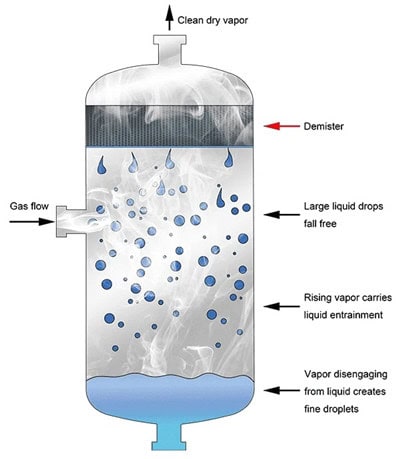
When a gas stream carrying entrained liquid droplets passes through a wire mesh demister:
Inertial Impingement: The gas turns freely around the narrow wire strands, but heavier liquid droplets possess higher inertia and collide directly with the wires.
Coalescence: As droplets collect on the wire mesh surfaces, they coalesce into larger drops.
Gravity Drainage: Once the gravitational force acting on the enlarged droplet exceeds the combined aerodynamic drag and surface tension, the droplet detaches and drains downward into the vessel sump.
The thickness of the pad determines the residence time and collision probability of liquid droplets inside the mesh matrix.
100mm and 150mm Demister Pads: Key Differences
While demister pads can be manufactured in custom depths ranging from 50mm to over 200mm, 100mm (4 inches) and 150mm (6 inches) represent over 85% of industrial installations worldwide.
Comparison Overview
| Parameter | 100mm (4 in) Thickness | 150mm (6 in) Thickness |
| Separation Efficiency | 98% – 99% | 99.5% – 99.9% |
| Typical Layer Count | 25 – 30 layers | 38-45 layers |
| Pressure Drop ($\Delta P$) | Low | Moderate |
| Gas Velocity Tolerance | Higher velocity window | Lower velocity limit before re-entrainment |
| Liquid Loading Handling | Moderate liquid carryover | High liquid retention & surge handling |
| Primary Advantage | Cost-effective, lower pressure drop | Maximum purity, ultra-low carryover |
100mm (4 in) Demister Pads: The Industry Standard
A 100mm thick demister pad is the general-purpose workhorse of mist elimination.
Best For: Vessels with moderate separation requirements, strict pressure drop limitations, or tight budget constraints.
Key Advantages:
Minimal Pressure Drop: Requires less energy to push gas through the bed.
Lower Weight & Material Cost: Requires less wire mesh material and lighter support grids.
Sufficient Efficiency: Captures virtually all liquid droplets larger than 5 – 10μm
Typical Applications:
Steam drums and boiler knock-out pots
General gas scrubbers
Atmospheric distillation units
HVAC & intake mist removal
150mm (6 in) Demister Pads: Enhanced Efficiency & Heavy Loading
A 150mm thick pad extends the gas flow path by 50%, significantly increasing the probability that fine mist droplets will strike a wire strand.
Best For: Critical separation processes where liquid carryover causes severe downstream contamination, or systems with high liquid loading.
Key Advantages:
Superior Fine Mist Capture: Achieves high removal efficiency for sub-micron and micro-mists down to 3μm.
Re-entrainment Resistance: Provides a deeper drainage zone that prevents collected liquid from being re-entrained into the outlet gas stream during flow surges.
Longer Service Life in Fouling Duty: Offers additional volume to trap suspended solids before blinding the mesh.
Typical Applications:
Vacuum distillation columns and fractionators
Amine absorbers & glycol dehydration towers in oil & gas
High-purity multi-stage flash (MSF) desalination evaporators
Sulfuric acid and chlorine gas mist elimination
Offshore production separators subject to vessel motion
Understanding Layer Counts & Mesh Density
A common source of confusion during procurement is equating pad thickness directly to performance without considering layer density.
Important: Layer count alone does not determine performance. A 100mm pad made with dense, fine wire can offer higher filtration efficiency than a loosely packed 150mm pad made with thick wire.
Demister performance depends on three interconnected parameters:
Wire Diameter : Typically ranges from 0.20mm to 0.28mm
Bulk Density: The weight of wire per cubic meter of pad volume 128kg/m3-186kg/m3(commonly for stainless steel).
Void Fraction : The percentage of open space in the pad (usually between 95% and 99%).
Application Selection Guide
Use this quick guide when choosing your demister specification:
| Application | Recommended Thickness | Recommended Material | Key Reason |
| Inlet Knockout Drum | 100mm | SS304 / SS316L | Low pressure drop; primary goal is removing bulk liquids. |
| Amine Contactor Unit | 150mm | SS316L / Alloy 400 | Prevents costly amine solvent carryover downstream. |
| Desalination Evaporator | 150mm | Monel 400 / Titanium | Prevents salt carryover into distillate steam. |
| Sulfuric Acid Plant | 150mm (Co-knit) | Alloy 20 / PTFE Co-knit | Captures fine acid mists in highly corrosive environments. |
| Boiler Steam Drum | 100mm | SS304 / SS316L | Standard steam purity requirements |
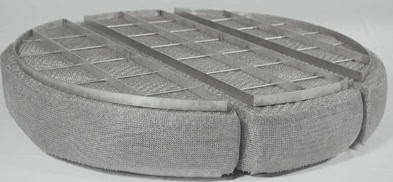
As a direct manufacturer of wire mesh demister pads mist eliminators, we engineer and supply custom-sized round, rectangular, and multi-piece sectional pads in stainless steels (304, 304L, 316, 316L, 321), Nickel Alloys (Inconel, Monel, Hastelloy), Titanium, and thermoplastics (PTFE, PP).
Need help calculating your vessel K-factor, pressure drop, or layer density?
Contact our technical engineering team today for custom calculations, CAD drawings, and factory-direct quotes.
Leave a Reply